Showing posts with label South American Tour. Show all posts

Monday, April 25, 2016

South American Tour: Panama Canal, Canal Zone to Buenaventura, Columbia to Long Beach

Wednesday, March 17, 1965 Enroute to Canal


St. Patrick's Day! The Nelsons, Bradfords and Dorothy Willison hosted a party in honor of the Finnertys and the other passengers. It was Planter's Punch and hors d'oeuvres for cocktail hour, red and white wine for dinner and cordial following games were played in the lounge. 

We had arrived in Limon Bay inside the brian water at 1 PM. There were a dozen other ships anchored nearby. We received the "news" shortly as an official boat came by and said we were scheduled for 8 PM tomorrow night, Thursday -- a 31 hour layover. Life hasn't changed a bit -- its still "mañana" -- Par for the course. The party helped to pass the time. Last year we went from the Pacific to the Atlantic. One can't say from west to east as the eastern end (Atlantic) is 27 miles west of the Pacific entrance.
 

Thursday, March 18, 1965 Panama Canal


This was the most uneventful day of the trip. We walked the decks and looked at the ships thru our glasses and tried to figure what was causing the delay. We didn't. Today there were 17 Northbound (Pacific to Atlantic) and 23 Southbound ships put thru the Canal, according to the official report. The Canal Pilot arrived by boat at exactly 8 PM. Our Captain came to lounge a few minutes later and said the passengers might use the flying bridge to observe progress thru the Canal. The anchor was hauled up and we were on our way. The moon was full as it had been on February 26, 1964, the last time we went thru. The ship traveled slowly. 

Gatun Locks
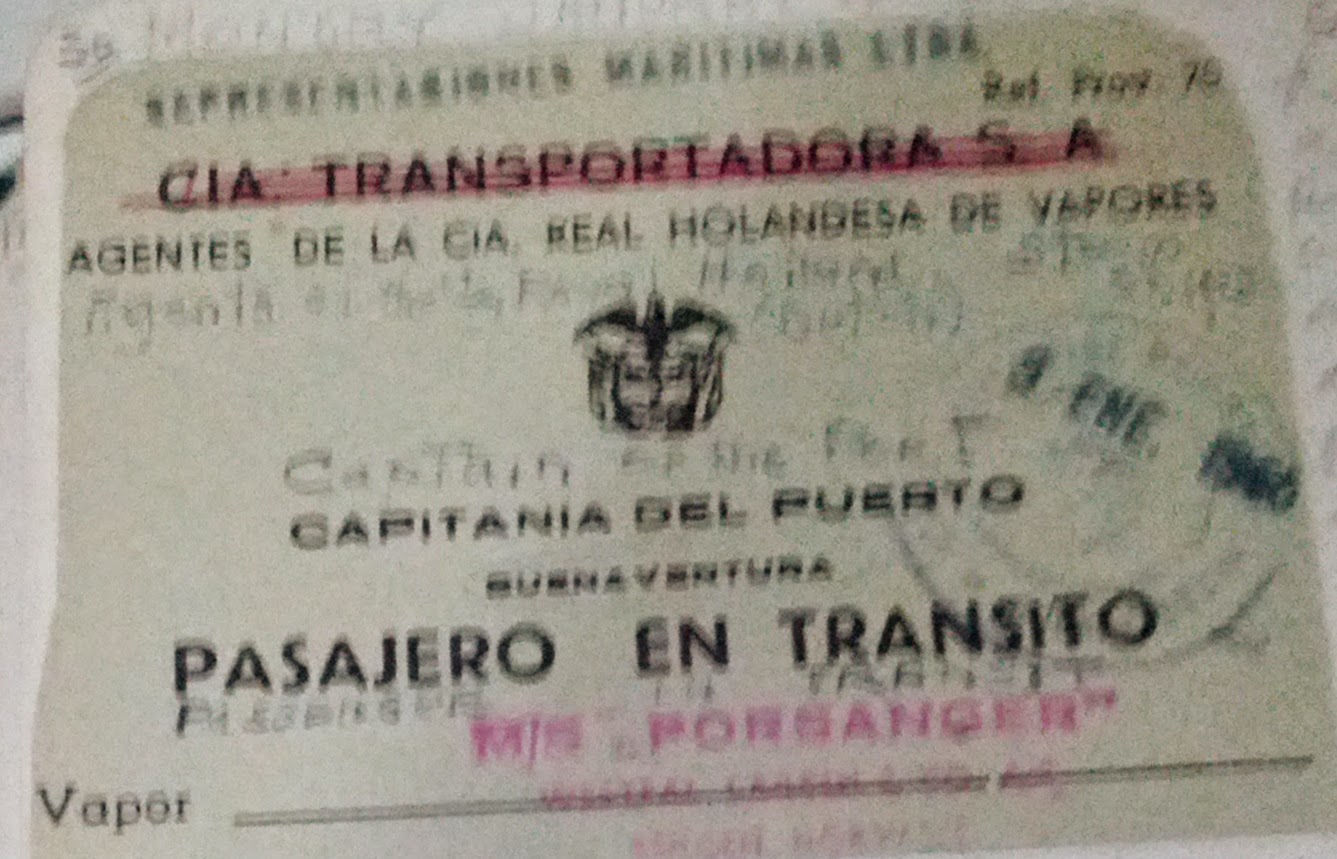
We are disappointed that we are going thru a second time at night. However, there is a possibility we may still see part during daylight. The Captain has been informed that the ship is to stop, anchor and wait for orders to proceed, as soon as we leave the Gatun Locks and enter Gatun Lake. If we stay there all night it will be a daylight trip for the rest of the way. It's midnight and all the passengers are going to bed. Starting of the Disel's will wake some and they will arouse the heavy sleepers. The ship has covered only 8 miles of the 50 to get to the Pacific. We decided to sleep thru the trip thru Gatun Lake and be called as it entered Gaillard Cut. It seems we only stop for two hours. That's the way the cards fell and we were on deck at 3 AM. It was slightly cool and very humid, with a full moon shining. The Canal is very narrow but well lighted all of the way. At the 40th mile we were into Pedro Miguel Locks and at 41 the two at Miraflores which lowered the ship back to sea level. Then we passed Balboa and saw the lights of Panama City and out into the Pacific where the ship headed south for our second stop at Buenaventura Columbia. We weren't impressed on our first visit January 4 and 5, 1965 so we will try to go over to Cali and then hope we can fly to Bogota the Capital.

Friday March 19, 1965 Enroute to Buenaventura


 Today's cool and humid we are 7°-8° North of the equator. The passengers spent all or part of the day catching up on lost sleep. I went to bed at 5:15 AM while Millie and Bea made toast and tea in the kitchen. Tomorrow, Buenaventura. There is a Question of whether we will be able to dock or must anchor and wait.

Saturday, March 20, 1965 Buenaventura, Columbia


The ship anchored a short distance from shore at 6 AM. At 7:30 AM it moved into dock. We were told then that we would sail out Sunday Night. This short stay eliminated the train trip to Cali and then a flight to Bogatá. Millie was sick during the night and was not interested in going anywhere. The Finnertys and Nelsons hired a taxi to go to Cali, about a four hour drive, stay all night and to return tomorrow. In mid-morning Millie and I took a walk around the town. We liked it better than when we were here in January. It was quiet and humid in the sun. Millie went to bed in PM and I walked over to town to get a haircut. The barber spoke no English and understood less. It was the cheapest I’ve ever had. Next one will be in the States. That last one cost me 4 pesos, about $.28 U.S. and that’s what it was worth.

Sunday, March 21, 1965 Buenaventura, Columbia


Victor Bradford has arranged for a small motor boat for the morning. Six went along. The little boat had a capacity of 12 and was powered by a new Johnson Twin outboard motor. It was an unusual trip. We went far into the jungle, the Rio Agua Clara rapidly narrows and we went in until there was scarcely any room to turn around.

Monday, March 22, 1965 Buenaventura Columbia


Buenaventura Columbia
Sailing time has been changed several times. This morning it is set at 4 PM depending on coffee. We are to take on 5000 in 4 pound bags. In the AM we visited the Grase Line ship Santa Mercedes. It carries 120 passengers and cargo. This Afternoon some of the passengers visited us. Word came at 3:30 PM that sailing would be at 4 PM and so it was. 

It was alos raining very hard at that time, the first time on the trip that the ship has traveled in the rain. Next stop Los Angeles, understand English is largerly spoken there!

Tuesday, March 23, 1965Wednesday, March 30, 1965 Enroute to Long Beach

This will be the longest non-stop run for the ship. It is 3046 nautical miles to Long Beach from Buenaventura. We move from 7°26’ to 36°25’ N. Latitude and from 79°00’ to 122°03’ N Longitude. The first three days the sea was quite rough and then it became delightfully smooth.

It was not quite a non-stop run. On Monday, March 29th, the motors stopped while we were eating dinner a few minutes later the Captain was called from the table. He came back later and said that one of the pistons had gone bad and there would be a 4 to 5 hour repair of it. The crippled diesel was staled and the ship was moved about five miles out of the ship lanes and then stopped for the overhaul. It was too deep to drop anchor so we just floated around. The air temperature stayed around 86° to 81°  the first 4 days, dropped to 77° the fifth day, to 63°  the next- the day we had motor trouble. As we neared Long Beach the air temperature dropped to 62° with wind and rain and then to 54° at San Francisco.

The ship was supposed to dock at Pier 41 in San Francisco which is adjacent to Fisherman’s Wharf. This would have been most convenient for us as our motel was only ten minutes away. We had also made reservations for the Bradfords who had joined the ship in Buena Aires.


However, there were so many bags of coffee in the hold that had to be unloaded before getting to the other cargo, it was necessary to dock at the Alameda Encinal Terminal across the Bay. The U.S. Custom Officers permitted us and the other passengers to leave the ship that night with overnight bags and leave the rest of our accessories (32 bags and boxes) on board until Monday when the ship would be at Pier 41. We were fortunate in having a ship supplier salesmen who came aboard offer to take the four of us over the Bay Bridge to San Francisco as he lived in the neighborhood, he dropped us at the Alpha Motor Inn. It was just midnight and our South American Tour was over.


Note from B-Dog: This is the end of the South American Tour by Ernest and Millie Saegart. I found the journals very interest especially as a time stamp from two people living in Southwest United States in 1960's. Just a note on Ernest. He was born in Connecticut in April 28, 1898 to Arthur Saegart and Cora (Sackett) Saegart and Died December 9, 1966 so about a two years after this trip was taken. 

A note about Mildred "Millie" (Elwell) Saegart she was born June 17, 1905 in New York to Raymond S. Elwell and Grace (Hutchinson) Elwell. She lived until February 24, 1994. Which means I have vague memories of her, which mostly involve dressing up her dogs in doll clothes, and trying to avoid getting lipstick on my teeth. 


Tuesday, April 19, 2016

South American Tour: Barranquilla and Cartegena Columbia

Saturday, March 13, 1965 Enroute to Barranquilla


The ship left Port of Spain, Trinidad last night at 9 PM. and headed west and slightly north too far off the coast of Venezuela to see land. Our destination in Barranquilla, Columbia. This is the only South American country that fronts both on the Atlantic and Pacific Oceans. We were on the Pacific side at Buenaventura on Jan 3, 4 &5 and our schedule calls for return. Barranquilla is a modern city of half a million seven miles up the Magdalena River, one of the great waterways of the Western hemisphere. It is the largest port and also the newest by about 200 years.

Sunday, March 14, 1965 Enroute to Barranquilla


This was the day of the flying fish. There was a bright sun and the sea was relatively smooth. As the ship plowed thru the sea and threw out it's wake, it apparently frightened the flying fish which were near the surface and hundreds of them in scholls of 100 or more and also singles appeared. Tom Finnerty won the daily pool on the number of miles the ship covered in the last 24 hours, so he put on a cocktail party at 5 PM.

Monday, March 15, Barranquilla


The ship docked at 9 AM. We arose early and packed a suitcase and hired a taxi to tour the city and then take us to Cartagena, the next stop for our ship, 85 miles southwest by road. It wasn't quite that simple! The driver, he spoke English mas o menos (more or less) agreed to give us the tour and then turn us over to his brother who had a better car, for the trip to Cartegena. The deal had several loose ends, but it was the best we could negotiate. The Finnertys were on this one, too.

We had a very delightful morning with a little shopping thrown in. We were able to buy some black market money at $13.70 pesos to the dollar, $9.99 to $1.00 is the official rate. We had lunch at the Country Club thru the courtesy of our ship's agent. During the morning we drove thru the market place which is most picturesque, with every thing from fruit to flamingos awaiting. Fish is halled direct from dugout canoe to customers on canal side of market. At four we drove to Del Prado Hotel to exchange cars and drivers. After a short delay both appeared. Our new drive also could speak some English. He had played ball with the Miami Hurricanes a few years back. At 4:30 PM we left for Cartegena over the Pam Am Highway. It was narrow, but paved except for about two miles on entering the city. The driver had to clear our trip with the local police before leaving town.

There were a number of check hales but that is par for the course. They are not repaired until Traffic is stopped. We arrived about 7:30 PM. We had intended to go to the Bahia Hotel but the drive stopped in front of a very new and good looking hotel. He went in to check on price and came back with a card -140 pesos with 30% discount about $7.00 for double. It was the Hotel Americano and had been opened only 3 months - of the 10 floors only half were completed. It has the only government licensed gambling Casino in town, but we couldn't go in because Tom and I didn't bring coats with us. We had a wonderful lobster dinner for less than $200 a piece and a view of the Caribbean, the beach and the canal. The Hotel was to secure a Taxi with English speaking driver for tomorrow.

Tuesday, March 16, 1965 Cartegena, Columbia


Cartegena lies on a sandspit of the warm shimmering Atlantic seacoast, the Spanish Main of history. It has a population of 100,000 good beaches and an excellent climate. Sir Frances Drake succesfully sacked the city about 1550. Then 70 million was spent on fortification and outer and inner walls surrounded the city and forts at advantageous points. Parts of the walls are still standing and in good condition. They are 40 feet high and 50 to 75 feet wide. We drove along the top of it. We visited San Felipe fort which was outside the walls and across a lagoon. It has an escape tunnel which descends by ramp about 300 feet, passes under the lagoon and exists in the inner wall into the city: it was never necessary to use the tunnels as an emergency. In 1741 Admiral Vernon led a British fllet of 190 ships and 27,000 men against the city. He was defeated.

Breakfast was finished at 7 AM and we found our driver waiting in the lobby. We toured the residential area where we saw some of the finest homes in SA, then we drove to the ship to check on departure time and to leave the suitcases. Sailing was set for two and we were to be back at one. Then we started out again.

We drove to the top of La Popa, highest observation point for many miles. From here we can see that the largest entrance to Cartegena is deceptive. This Boca Grande allows water to flow, but ships cannot pass as an artificial reef blocks the mile wide channel. The Spaniards, in 1741, installed a masonry wall across the entrance, a magnificent engineering feat! Boca Chica six miles south and behind Tierra Bomba Island is the only entrance for ships.

We then drove over to the Fort of San Felipe. The church and monastery of St. Peter Claver was visited. He was a Jesuit who dedicated his life to helping slaves. he baptized more than 300,000.

When we went out for dinner last night we left the glass door to the canal ajar and the lights on. This morning Millie was covered with insect bites. Some of which raised some big welts. There are no window or door screens in SA. The ship sailed at five o'clock for the Panama Canal. We hope we can go thru in the daytime last year it was at night.

Tuesday, April 5, 2016

South American Tour: Salvador, Brazil

Sunday, February 28, 1965 Enroute to Salavador, Brazil

Millie was sick with upset stomach during night and stayed in bed until dinnertime. Though quite warm, the wind blew at gale proportions and made the deck uncomfortable and the sea very rough.

Monday, March 1, 1965 Salavador, Brazil

Sea much more calm. The temperature of the sea at noon was 88° and of the air 84°. At that time we were exactly 15° south of the equator -- 900 miles. Actually the ship will travel quite a bit farther to reach the equator as it will go in a northwesterly direction as soon as it passes the bulge on Brazil's eastern shore line.

The ship approached Salavado about 8 PM. From the ship, the extensive lighting seemed to indicate quite a city. At 9 PM the anchor was dropped a mile of shore and the passengers knew that was it for the day.

Sao Salavador da Bahia de Todos os Santos to give the town its full name is the capital of Bahia state and fourth largest city in Brazil. The population is about 700,000. The city is divided into two sections with the Baica or lower part and the alta or higher part on a small plateau some 200 feet above. The lower city has the commercial quarter and the picturesque market with its negro vendors. The government building, shopping district, hotels and restaurants area are in the upper city reached by motor roads and four elevators and two cable car systems.

Tuesday, March 2, 1965 Salavador, Brazil

One note very few people with white skin here. It is claimed Brazil is the best or worse integrated country in the world and here is the best or worse city. The South American handbook (1965) states that in all of Brazil 61% are white and multiracial about 21% and 15% black.

It's the last day of the "Carnival" and our ship is still anchored out in the bay. Nine of us boarded a water taxi for shore, took an elevator to upper level area and walked over to the central square. There was a temporary reviewing stand with a large platform for the entertainers. It was 10 AM and there was only impromptu dancing going on and only a few in the stand. We asked the soldiers on duty if we could rest in the stand and take pictures. The Vector Bradford our new passengers handled the language barrier easily. They have lived in Argentina for years. They were told to go to their headquarters - about 200 feet away - and get a pass. Imagine our surprise when we learned the passes were good until midnight.

We entered the stand at 11 am and picked seats shaded by large trees. Still only a few people in stand. Millie and I staged until 7 PM. Most of our group remained until 11 PM. It was one continuous round of rhythm dancing by one group followed by another each allowed about 10 minutes. The populace were certainly on their best behavior which was unusual for a carnival. However we learned that the sale of liquor is forbidden during carnival time, which helps a lot. Also, there were many police stationed around. It was apparent that they were well trained from the way of handling the crowds and the individuals. I have never seen so many people packed so tightly in such small places. I took lots of movies.

Wednesday March 3 1965 Salvador, Brazil


"Ash Wednesday" Lent has started and the S.A. Carnivals are over until next year. Our ship came into dock in early morning and we are spared the trouble of securing a water taxi. The Fennertys, Millie and I took a taxi tour of the town and we were highly impressed by the beautiful homes and excellent landscaping.

Our ship is to take on a load - 700 tons of castor oil at the port, but no one seems to know where the oil is and the local agent can't be located.  The oil showed up late in the afternoon in a lighter being towed across the bay with a most decrepit tug. It took an hour and a half to get the large load in place and anchored, the steam line for pressure was broken and had to be extensively unpaired and other details. Then the crew wanted to attach the steam line to our ship's system. Our vessel is a motor ship (diesel) and not a steam ship. The only steam we have is a small boiler for hot water and not big enough to operate the steam pump on the lighter to raise the oil in the ten inches over the side of the ship.

In South America that's par for the course and now transfer of castor oil is really manana of all. so the little tug left with the large lighter full of castor oil and we stay right at the dock for at least another day.

Thursday March 4 1965 Salvador, Brazil

About 9 AM the lighter returns with the aid of same decrepit tug, but a heaither looking tug also shows up and ties on other side of lighter. Step by step, all of the preliminarals were reenacted.

10:30 AM transfer was started with the healthy tug furnishing the steam. I neglected to mention the number of experts needed for the operation C.O. Our ship had 3 officers, and 8 crewmen, the sick tug had crew of five who participated half heatedly, the big tug a crew of 8 who worked at the source with the four on the lighter. On the deck there were 6 stewardors and 6 more in the hold. Then there were standed supervisors, agents and assistants for the ship, ditto for shipper, the customs pepole and the checkers. There were probably more but I went to town. Now you know why a shot of castor oil is so expensive and this is only one little day in its life. Anyway the load of C.O. is for the air france and they are going to give it to their planes.

The C.O. was loaded by two and the ship sailed by 3 PM. I was worn out so I took a nap.

Our next stop is Bridgetown in the British West Indies on the Island of Barbados, 2471 miles away. It will be our longest water span so far.


Tuesday, March 29, 2016

South American Tour: Rio de Janiero, Brazil

Friday, February 26, 1965 Rio de Janiero, Brazil

We arose at 6:30 AM as the ship was coming into Rio harbor. There were about 40 ships in this Bay of Guanabara waiting for dock space and our ship joined them. Rio is a city of 3,300,000 people it covers an area of 431 square miles and is built on and around 365 mountain peaks with many bays and lagoons. The Santos & union airport for domestic flights is in the down town section and ocean going ships are docked off-port of the main street of the area. 

A word about their money. In "Pan-Am's World Guided," revised in 1961-2 it lists the cruzeiros as 190 to 1 dollar US. In the South American handbook it states that the value had dropped to 920 to 1 dollar US as of 8/14/1963. We exchanged U.S. dollars for 1810 to 1850 while we were there. What a shook to own a home or have money in the bank and watch nearly 90% disappear in less than five years. 

On a tour we visited the Copacabana Beach, the celebrated bathing place, Hunchback Mountain (Corcovado), their one we drove to the top 2330 feet above sea level, the highest of Rio's 365 peaks and on top is a 120 foot statue of Christ the Redeemer. It was a great spot for taking pictures. Twice we tried to take the cable car to the top of Sugarloaf Mountain (Pão de Açúcar) but there was a delay of 2 to 3 hours because so many others had same idea.

We made reservations for four at the Copacabana Palace Hotel for dinner at 10 PM and nite show at 12:30. Cover charge 80,000 cruzeiros (about $43.00) for four. At 5 PM we decided to go back to ship to rest and freshen up for our nite on the town. The ship still anchored in Bay so we hired a water taxi for 8,000 cruzeiros. We could have waited until 630 PM and returned in agent's boat for free but we were too exhausted. In fact, we were so warn out that we passed up returning to Copacabana. When we thought of fighting the language barrier for food, water taxi and land taxi, especially at 2 AM we just didn't feel up to it. Coffee from Rio was loaded on the ship from lighters starting at 8 PM. I don't know when they finished their job.


Saturday February 27, 1965 Nite-Roi, Brazil

Sugarloaf

At 6 AM the ship pulled anchor and crossed to other side of bay to dock at the town of Nite-Roi, Capital of the State of Rio de Janiero where more coffee was taken aboard. We rose at 7 grabbed a cup of coffee, went ashore took a taxi to ferry to Rio. There were about 3,000 on their ferry and they run every 15 minutes. It takes about 10 minutes to cross the Bay. Then we took taxi to Sugarloaf to take cable car to top. There was a delay of 1.5 hours but we decided to wait. The trip is made in two stages starting from bahilonia Hill in Praia Vermelha (Red Beaches) to first stop at area 770 feet high. Then we walked across the top and entered a building where we waited forty-five minutes to take another cable car. Finally, our turn came and we went aboard with 20 other passengers. The car travels 2688 feet across land and water haging all of the distance from the cable with no ground support except at each end. At the top of Sugarloaf we are 1300 feet above the Bay from where the mountain rises. At each stop going up and coming down there was a delay to do so many families coming to Rio for the annual carnival which starts today. At noon and lasts until midnight Tuesday - actually each year until the beginning of Ash Wednesday. It was quite a day very humib and very hot in the direct sunlight. Distant scenes will not by too good in the pictures. I took because of the heavy haze. 

Before we left we were noted that ship would sail at three, so we were concerned about connections we would have to make getting out of Rio and the inevitable delays. There's a real language barrier in Portuguese speaking Brazil and it worsens when one is in a hurry, because with these people as with the Spanish it's always "Manana." The connections clicked and we were back on ship at 2 PM. Nevertheless, it had taken us 6.5 hours to make the round trip. The ship left the dock at 4:15 PM and sailed out of Guanabara Bay into the Atlantic at 5:10 heading for and due in Salvador (Bahia) Brazil) 748 miles Northeast, Monday Night.


Monday, December 1, 2014

South American Tour: Buenos Aries


Friday, February 5, 1965 Buenos Aries, Argentina

It is an all night boat trip to Buenos Aries on the Rio de la Plata. The ship left the river channel and entered the dredged channel to the city. The river is a dirty brown color carrying a tremendous amount of silt hence the continual drudging. B.A. has a tremendous dock area and every bit is used. When the ship reached a certain spot, two large tugs came over, one in front and one in back and took over towing the ship stern first. They went thru a narrow ship which was a street-crossing with a turn table bridge. When open we slid thru with about 12 inches to spare on each side. B.A. is 123 miles up the river from Montevideo, it is the seventh largest city in the world with a metro population of 7.5 million. We were cleared by immigration by 10 AM and then the ship's agent took over. He interviewed each passenger and filled out quite a form on each one. Then he had men gather up all the luggage and put it in a truck. Passengers were loaded into two Cadillacs. (It was understood at the start of our trip and written in our tickets contract that we would be required to maintain ourselves ashore for 2 weeks in B.A.) Next stop was customs. All of us went into the building and our luggage arrived a little later and was brought in and set on tables where the officers gave it the once over. Millie had picked up the "bug" and was getting sicker by the minute. I spoke to the agent about her illiness and allergy to smoke so he hired a Taxi for us and we were at Gran Hotel Dora in a few minutes. (The Hotel is pronounce Doe RAH in Spanish) She went right to bed and too sick to eat. The maid on our floor was of Irish descent and spoke good English. She was wonderful and looked in on Millie every half hour.

Saturday, February 6, 1965 Buenos Aries

Millie feeling quite a bit better, she is now drinking tea and eating toast. She was feeling strong enough to take a short walk on Avenida Florida. It is a block over from Maipu which is the street our hotel is on. Florida (Flo REE da) is closed to automobiles so it makes a wonderful place to promenade. It's also one of the principal shopping streets. The sidewalks are in bad shape but little or no repairs are made, besides being extremely narrow. It is just unbelievable that a city this size and class would permit such a situation to exist - even the guide books comment on it. It is so noticeable because few individuals have cars - too expensive - and walking is a national sport. In the PM Millie felt well enough to a walk for window shopping. The shops were closed - English Holiday, you know. She was agog with all the bargains in the windows. Their money is officially pegged at 152 pesos to 1 US dollar, but Argentine money can be bought for cash in most any "combio" for at least 200 to the dollar and we are buying it today for 217. I bought $100 worth and received 21,700 Pesos. We had a steak lunch for two for less than 400 pesos.

Sunday, February 7, 1965 Buenos Aries

The hotel dinning room is really a tea room w/4 tables and a 4 stool bar. They serve sandwiches, steaks and chicken. We met a couple at one of the tables, the man helped us order a meal. Then we asked him it he spoke English - he said he was from Meriden, Conn. Then we met 4 girls from La Paz, Bolivea. Their husbands were colonels in U.S. army helping the Bolivian Army and they were on a buying trip to B.A. There are quite a few English speaking people at the hotel - 3 Canadians with American CanCo. who are installing a plant and instructing the natives on how to run it.

Monday, February 8, 1965 Buenos Aries

Finally the first business day of the week arrived. All of the women folk were so anxious to sally faith on a look and buy expedition. Millie was no exception. The pace was too slow for the men, so we usually agreed upon a meeting place for meals. Leather good and silverware are the eye-catches. Returned late from dinner. Ten PM is the height of the dinner hours. Weather warm but not too hot as there always seems to be a local breeze.

Tuesday, February 9, 1965 Buenos Aries

More shopping and then comparing purchases at the hotel. Pocketbooks are a favorite item and very cheap by U.S. standards. Went looking for a 'combio-Change" and found one that would give 223 to 1 for each. Travelers check are less and some combios wont take them at all. 223 is tops and hard to find. The hotel ships an English written newspaper under door every AM. It keeps us up to date on any news note the TV program taken from it.

We buy Time Magazine printed in English and flown in by air. it is the regular South American edition for 45 pesos, about 20 cents. It has less advertising and runs about 60 pages. There are four TV stations here 7-9-11-13. Somehow the titles sound vaguely familiar. There are 63 cinemas listed in the paper, many showing U.S. films. TV sets are available for use in our hotel room but no one has had time to look at T.V.


Note that this is the last page from the South American Tour 1965 book. I think there is another book that goes with it, I know I have seen another book. So I will try to find it and keep going. But for now this is the last posting of Ernest and Millie's Trip.

Monday, November 24, 2014

South American Tour: Punta Arenas, Chile and Montevideo, Uruguay

Friday, January 29, 1965 Punta Arenas, Chile

This would be our last day of heading south and we would also leave Chile before the night was over. The sun was shinning brightly when we got up. Then it became cloudy and rain squalls appeared and stopped. The wind blew a gale Winter had returned for a day. We were cruising between the 52 and 54 degree parallels approximately the same distance south of the equator as Calgary, Lake Louise and Banff is North of it. At 11 am we rounded the point in the Estrecho de Magallaneo which is the southern most point of the continental Western Hemisphere. There are many islands south of this and of course the large island of Tierra del Fuego (30,000 sq miles)

Everyone took pictures of the southern point and the ship came up with a long blast of the foghorn as it turned from southeasterly to northerly direction.  Now the Strait became very wide and quite rough. At two PM we came into Punta Arenas, the southernness city on the main continent. It is 1432 miles from Valparaiso the population is about 47,000. One third of Chile lies south of Puerto Montt but its land and climates is such that it can be put to little use. Less than 1% of Chile's population live in this area. It is one of the rainiest and stormest regions on earth -- 200 inches of rain fall on some of it. But it is beautiful to behold.

We went ashore shortly after landing I wore a top coat and Millie a heavy cloth one. When facing into the wind it was quite raw. The town is a freeport but there are many bargains, German films is three times the price of the same made in the U.S. We spent our last escudos, pesos, and centavos for local liquors and got eight quarts for $10 American.  We returned to ship for dinner. At 8:30 PM unloading was completed and at nine, still light, the ship backed away from the wharf. Next Montevideo, Uruguay -- 1300 Nautical miles away.

Saturday-Monday January 30-February 1st, 1965 Enroute to Montevideo, Uruguay

Our destination is 1300 miles away, without a stop, out of sight of land. The sea is slightly rough and the weather cloudy with quite a bit of wind. Sunday night we had the Captain's Dinner, preceded with hors d'Oeuvers and cocktails at five and a special dinner with the Scandinavian national drink. Monday was spent sorting our clothes and accessories following several days at Montevideo we sail across the and up the Rio de la Plata (170 miles) to Buenas Aires where we leave the ship for 10-14 days. We have to pack what we leave on ship as our cabins are to be redecorated. Monday Night we saw a satellite travelling northwest over the ship.

Tuesday, February 2nd, 1965 Montevideo, Uruguay

Montevideo was sighted around noon. Entry from the Atlantic Ocean is tricky altho the Plata River is at least 100 miles wide at this point. It was mid afternoon before we docked and another 1/2 hour for clearance. We took a taxi with the Finnertys to the center of town. Walking around we ran into the Nelsons, Montes, Hazel Lewis and Marian Pearl. We also saw Dorothy Wilson, all passengers on our ship. We did not see a negro. Our guide books tell us that there are very few in the entire country.

It was a delightful day with temperature of 77 but a stiff breeze. The city is located at 34 degrees south latitude and its midsummer here. Los Angeles is 34 degrees north latitude. We returned to the ship for dinner. I put on a heavier suit and Millie took a coat. We returned to town the wind was still blowing.  Millie bought a coat of baby antelope skin. We found the win too disagreeable to walk so we taxied back to ship. Oh yes! We received letters today from Mary Lou and Bill, Betty and Roy Walleson, Avis and Roger and Millie's Aunt Jenny.

Monday, November 10, 2014

South American Tour: Santiago, Concepcion, and Talcahuano, Chile

Friday, January 22, 1965 Santiago to Concepcion to Talcahuano, Chile

Up at 6:30. Packed to take the eleven hour trip to Concepcion. We were on a coach with all seats reserved. There were several other coaches, but ours was the only one going to Concepcion. Every coach was crowded and 2/3 were children, but the best behaved youngsters I have ever seen. Never was one allowed to run in the aisle or annoy adults. They just sat in there seats for hour after hour. We left the hotel at 9:30 AM., the train departed at 10 AM. It was pretty much of a milk run, but they amazing country side between two chains of the Andes Mountains. Excellent farming and grazing county. By the time we arrived in Concepcion there were at least 50 passengers without seats, standing in the aisle of our coach with their bags and boxes.

We became acquainted with a young chap, Alberto Duharn McInnes a native who spoke excellent English with a Scottish burr. One of his grandfathers was a Scot, the other a Frenchman and his mother a Chilean. We had an excellent dinner on the train, altho the waiter had trouble with our English. At Concepcion, our new friend for us a taxi and instructed the driver to take us to three hotels, in case one or two did not have double rooms with twin beds. Imagine our surprise when all three told us no rooms at all, neither could we find any at other hotels. The driver took us to some others, most pretty bad. So we told the driver to take us back to Railroad Station and we would prepare to sit out the night. The lunchroom, telephone, office were closed up, but the waiting room still was open. We left Tom with the luggage and Millie, Bea and I went looking for a phone to call ship's agent to find out where the ship was.

At a nearby hotel we started, the clerk knew no English, but he tried valiantly to help. Jones was the name of the agent, but the number we had was no good. There is no info dept. or phone co. We wanted to contact the park authority who might give us some info. The clerk finally spotted, "Maritimas" in the phone book, phoned it, and asked for Mr. Jones phone no. They had it! A contact was made with Mr. Jones and he told us the ship was in Talcahuano (pronounced: Talca WANA) the Chilean Navel Base 17 KM away. He was sure we could go thru the base to our ship if we had our passports, we did. Our spirits picked up as we hired a taxi. We checked at the gate of the naval base headquaters and were given definite directions to our ship. Apparently, Mr. Jones had phoned to expect us. Man o' Man did that bed feel good. It was one-forty five in the morning.

Saturday, January 23, 1965 Talcahuano, Chile

Today, large sacks of flour are being unloaded, donation by the U.S. to the starving Chileans. Some of the passengers walked the short distance over to the highway where they took the bus, after waiting an hour, to Concepcion. The town observes the "English Holiday" so little shopping can be done on Saturday afternoon.

Sunday, January 24, 1965 Talcahuano, Chile

Still unloading sacks of flour. Weather still beautiful. No rain since we left San Francisco December 14th. Temperature cool, very enjoyable. At 5 PM unloading had been completed and hatches closed and the ship took off. The pilot who will take the ship thru the inside passage and Strait came on board bringing his wife who will be with us until we reach Puenta Arenas. He does not go to work until we turn into the channel 390 miles away.

Wednesday, October 15, 2014

South American Tour: Cerro Azul and Ilo Peru

Thursday, January 14th, 1965 Cerro Azul


It was just a month ago today that we sailed out of San Francisco Bay on this trip around South America. We have made 11 stops, one in California, three in Mexico, one each in Canal Zone, Columbia, Ecuador and three in Peru. We have traveled about 3300 miles by ship and a 1000 miles by plane.

When we arose at seven we were anchored in glass-smooth water off the town of Cerro Azul (Blue Hill) Peru. We are some distance from shore and there are no water taxies available. WE expect to depart for Ilo between 11 and 3. No cargo was unloaded, but lighters brought cotton bales that were taken aboard. We left for Ilo, Peru at 12 noon our last stop in Peru.

Friday, January 15th, 1965 Ilo, Peru


Another beautiful day altho we are still in the tropics the temperature is in the 70's. Sea fairly calm. The passengers spent most of the day writing letters and cards. When we rested the Spragues in Lima, Rod said he would try to contact the Southern Peru Copper Corp at Ilo and make arrangements for us to visit smelter. When we docked at 7 PM a man came aboard with immigration and customs looking for us. IT was the port administrator, Coenroad Vasseher, a Hollander, who worked for the copper Corp. as they owned the dock, the only one there. Coenroad took Millie and me and five other passengers out to the company town where we picked up handbook, asst. super. of the smelter and then we drove North on an excellent road (The corp owns and maintains) for nine miles to the smelter. We had a pleasant and informative experience touring the operation. Then we went back to co. town to Co. Club and were treated to drinks and we arrived at dock at 11:30 PM. Our two hosts came aboard and we treated them to drinks. At midnight the ship left for Iquique, Chile.

Monday, September 22, 2014

South American Tour Lima, Peru 1965

Saturday, January 9th Quayaquil to Lima

Up at 5 this morning. It seemed hopeless to get a hold of our passports and make 7 am plane. All of us started phoning. Millie contacted Miss Lola who said she had located our passports and gotten Velasquez's phone number. Millie phoned him and he just wouldn't cooperate, because we had gotten him out of bed and it was the railroads fault for not running on Friday, not his. She begged pleaded and cried but "no go." Then we tried Castro and called the American Consul. Finally, a change came over him a taxi showed up at the hotel, driver had note with my name on it and word "passport." I grabbed Tom Finnerty and away we went. The driver could not speak English so we did not know where we ended at Valasquez Office and he was sitting calmly at his desk. It was now 6 am. I had not even combed my hair...I don't know whether the taxi was the one Braniff sent or not. They had had one out all night trying to locate Velasquez and had found him and he had the four passports. He had taken Finnertys to get them a Peruvian Visa and supposedly the same for Millie and me. Although I had a Peruvian landing card and I already had one. The just wanted the passport for security until we paid for the tour. Finally he started to prepare the landing cards for the Finnerts (I filled ours out in Denver after buying the card from Steamship co. for $4.00 Tom's cost $5.00. then he made out a bill for plane to Quito etc. came to $102.00. It was ten minutes to seven. Tom had called Bea and told them to check out, pay the hotel bill and bring luggage to airfield. We arrived at 7, the girls were there. Then found the plane. It was a New York & Miami one would be an hour late. McBancroft, our ambassador was there also.

We Purchased our plane tickets from Miss Lola and thanked her profusely for the excellent help. She was really a gift from the gods when needed. (She had spent several years there and had some travelling difficulties of her own so she knew what to do with our problems). It took the jet one hour and 30 minutes to cover the 1000 miles to Lima, Peru. We had an excellent breakfast on the plane - the first meal we had had since breakfast in Quito. Off the plane and through immigration (good passport -- the next one is going to get an argument when he wants my passport) and customs. Customs just patted our bags and said OK. But gave Tom and Bea's a good going over. After buying some Peruvian dinner at the airport we took off in a hotel taxi for Gran Hotel Bolivar. Excellent rooms on sixth floor and then a couple of Pisco Punches in tap Room -- the first one on the house. Wives went shopping, Tom and I went for hair cut - Chinese barber spoke Spanish but no English. Karen, our granddaughter who is making a four month visit in Peru came to the Hotel with her Hostess Senora Lopez and her two daugthers, Ana who had spent four months in Karen's home in Tucson and Marie (13 years) also Jose the 15 year old brother. We had lunch in Hotel - $48.00  and they invited us over to their home for a surprise party for Karen's 11th Birthday. In the meantime Joey Murz phoned. We met him in Tucson he works for ASARCO and spent 10 years in Peru. He was going to the party and would pick us up. Then Heather Sprague phoned. They were also coming to the party and she invited the Lopez family, Karen aned us to Lunch on Sunday. We took a nap, dressed and left hotel with Joey for party, around 5. the party was an example of Spanish Culture and manners. There were 11 Peruvian girls there with adult friends dropping in all evening. Many of them brought Birthday gifts. The girls danced square dance, tangos, cha-cha etc. One played accordion. Food never stopped coming with soft drinks. The Lopez took us to hotel about ten Mr. Lopez who also works for ASARCO, is Caja Metro, 844 Kms north,  where the company has a branch. He is an Engineer.

Sunday, January 10, 1965 Lima

We were called at 8. Had breakfast, packed, checked out of hotel and left baggage at desk. The Lopez with Karen called for us at ten and we toured Lima and surrounding residential areas and the beaches ending up at the Spragues at 12:30 for lunch. Left Spagues with Lopez stopped by Hotel for bags and ran into Tom Finnerty. he said they had picked up a tour agent who was arranging trip for them to Cuzco and Machu Pichu, 3 dars for $109 and $30 more would get them to Ilo to rejoin ship. With the Comedy in errors on the Quito Andrean trip so fresh in my mind I wasn't too interested in the Spanish brand of tour agents but Millie warmed up to it as she wanted to see the Inca headquaters which was so well hidden that it wasn't discovered until 1911. So we told Tome to get two trips for us and then we left for the ship in Callao in the Lopez car. Mrs. Lopez parked car outside the gate and we picked up luggage and walked over to gang plank, there a guard stopped us and called a customs officer. Jose and his mother jabbered away in Spanish with the two officers. It appeared I couldn't take the luggage on board until it had been inspected by customs, this customs officer couldn't do it and the officer where it would have to be done was booked until Monday. The discussion went on for 15 minutes. I went on board to get the bursar, he went to get some one else. I returned to the melee when I notice Jose carrying the luggage up the gang plank. He said they had changed their mind they could inspect the baggage and would do it in my cabin. I opened one bag and that was it. It cost me two cartons of cigarettes. I still don't know what it was all about. The bags had been inspected when I landed the day before and carried the approval stamp.

At 6 PM the Bursars informed us we would have to let him know definitely whether we are staying on ship or taking another land trip. It appears the ship must carry papers as well as the agent with the exact whereabouts of their passengers. One cannot stay away over night without a definite reason for the police. This was news to us. Millie walked along the dock for 5 blocks to a phone ot call Tom Finnerty to see if he had gotten our reservations for Cuzco. Then she learned Tom had been inquiring around and found that the planes used on part of the trip were having maintenance trouble and were frequently delayed. The manager at the Bolivar Htoel told him it was not a trip to be taken on a tight schedule. Tom and Bea backed out and we considered our trip postponed.

Monday, January 11, 1965 Lima

Had a good sleep on the Porsanger. Difficult to get up for breakfast, but made it. Rays Mortin and wife had left at five for Cuzco trip. The Nelsons were going in a separate group but they had a joint Peruvian landing card and it wasn't acceptable to the powers that be. They had to wait for immigration to open. Dorothy Wilson is going with them. We walked five blocks to a phone to call Rod Sprague, mgr of Northern Peru Copper Co and tell him we wouldn't be in Ilo, Peru until Friday. He was trying to arrange a trip to the smelter. Also phoned Karen that we would send her camera which she had left on the ship, to the agents office in Lima. Later learned it went to agent in office in Callao. Hope the Spaniards can figure it out for her. The Finnerty's showed up at 11 am and walked aboard with their luggage without immigration looking there way. Shortly thereafter Senora Ida de Avirta and daughter came abroad. They were friends and neighbors of the Finnertys in Arcadia Calif. and now returned to live in Lima. Our 11 am sailing was set back to 3 PM so they took us for a ride around Callao, returned to ship at two. had sandwiches in our cabin. Ship took off at 3:15 pm for Huacho which is north of Callao but passed on the way south because too many ships were waiting. Then we took a nap until 5:30. had dinner on ship and chatted in lounge. Shipp approached Huacho at 8:45 PM and dropped anchor. The City Lights were very attractive. Will see the town in the daylight tomorrow. The sea is slightly rough due to the cold Humboldt current rushing north along the coast. Streams from the antarctic and cools off the coast line along the tropics and also makes for excellent fishing in Peru. It also rolls the ship somewhat in this unsheltered harbor.
 

Tuesday, September 16, 2014

South American Tour: Quayaquil, Ecuador (1965)

Wednesday, January, 6th 1965 Enroute to Quayaquil, Ecuador

This was the day we would cross the equator. The Captain announced it would be shortly after noon, so the ceremony was set to follow the noon luncheon. We received an "official" summons to attend the trial in bathing suits. We spent several hours in preparation so that the polywags could appeared as captured pirates of Henry Morgan's Crew: we waited until all the others were seated then we entered thru the kitchen door. There all of us were tied and roped together and led by Morgan at a funeral dirge pace. Then we marched twice around in complete silence. "Lags," Martin said later that he was afraid we had stolen the show. After the luncheon we convened on the after deck. Each neophyte is brought before King Neptune tried for some offense and, of course, found guilty, and sentenced to execute certain duties. The Captain and Chief attended the entire performance.

Thursday, January 7th 1965 Quayaquil, Ecuador

The ship docked at Quayaquil at 7 AM. The Finnerty's and we had packed for a trip to Quito. We left after breakfast and walked over to Customs on the dock. Had to wait until an officer arrived. Passed OK. Then to ships agents office. He turned us over to a Senor Olmedo Velasquez of Servetour. 

Thursday, January 7th 1965 Quayuaquil to Quito, Ecuador

Valasquez was to line up a plane trip to Quito and return by train the following day. here is what South American Travel Association says about train trip:


The plane was to leave at 12 noon. We waited, waited, waited, in the agents office for Taxi. According to Spanish Customs its a waste of time to hurry. The taxi showed up at 11:40. Fortunately, the plane was late, left at 12:40. The fare was 508,80 sucres - $28.00. we were in Quito in one hour and 30 minutes. We were above the clouds all the way so we didn't get to see the Andres. Went to Humball Hotel in center of town, took a taxi tour around the town, had a guide who spoke good English - son of a general in Ecuadorian Army and back to Hotel. Told the Clerk we would check out tomorrow morning and take train back to Quayuaquil. He looked queerly and said softly there is no train to Quayuaquil tomorrow. From here on in confusion reigned. If we waited over to Saturday for Train, then there was no plane to Luna all weekend and we could not rejoin ship. Karen's birthday was on Saturday and she was delighted in Lima and we had promised to be there for her birthday.
Airport Ticket


Uruguay Peso
The Finnerty's ran into a civil engineer in the Hotel who was from Montevideo (Uruguay). He spoke excellent English and he helped us with our problem. We tentatively decided to hire a taxi and return over the service highway which makes a similar trip to the train. We had several calls from ship's agent to Guayaquil who had evidently discovered the tour agents error in the train and wanted to know what we where going to do. We didn't know either. So we went to Hotel Quito for dinner and took Juan Gonzales the chap from Montevideo with us. Had steak - only fair. It had started raining while we were in the hotel and was still raining. The taxi driver was waiting for us. So home and to bed. Room quite cool - but no heat in Quito.


Friday, January 8th 1965 Quito to Quayaquil

Up at six. Decided to taxi back to Qauyaquil. Packed, had breakfast, paid hotel bill and loaded luggage in trunk of 1954 Pontiac Eight and away we went for Qauyaquil 266 miles away. Had to advance the driver $1000 for gas and oil. We soon discovered on a slight grade that the motor was not in good condition no power, and we had two Andean Mountain ranges to go over. Nevertheless it was beautiful and unusual. We have never seen the farming on the steep sides of a mountain, the weather, at one place we ran into an Indian ceremony. we heard music and looked up on the side of the mountain and there they were some with painted faces,others with masks. When the car stopped all of them, about 50 came down the slope and surrounded the car. Then came the inevitable hand-out we paid off and got going. The Andes are not in the rugged class except where they go about 15000. They are heavily foliage and much of it is under cultivation, most of it on slopes so steep it does not seem possible to plow but plow they do.


We saw small active volcano. Later in the day the driver missed a road and we went on for miles, no signs, no town, no houses, no gasoline stations and the needle quite bobbing around. We found a station before it was too late and had a coffee and roll. It was 4 pm and we were 125 miles from base. We were averaging 25 miles per hour. At no time had the driver pushed passed 75 kms or 50 miles an hour. Back on the road. It hadn't been good since we left the Panama Highway in mid morning. Now it was worse. The driver zigged and zagged to dodge the chuck holes.

While at breakfast this morning we had a phone call from Larson agent in Quito. He said had a request from the agent in Guayaquil to check on our time of return to our ship. I told him we were leaving by taxi within an hour and the driver thought we should be in by seven. Had some one check on our plane reservations, plane to Lima, hotel for tonight, and get our passports ready. To emphasize I had Millie repeat the whole thing.

The driver got lost several times came in on wrong road which added 50 miles to trip had to change a tire and slowness of car resulted in it being 11:30 PM before we arrived.


Our hotel reservations were for June 7, not for tonight but there was plenty of room. No plane reservations on Braniff for Lima and the tour agent couldn't be located. We spent the next 2 hours telephoning. Millie found one bright spot in the Spanish and that was Senorita Sofa al Braniff Air lines in Quayaquil. She was most sympathetic and offered to help. She said she would be tied up for an hour with Braniff planes coming in and departing but said she would attempt to located the man with our passports. (We were scheduled to fly out to Lima at 7 am, but we couldn't land without passports), At 1:15 we decided to get some shuteye and leave it to Braniff.

Monday, August 25, 2014

South American Tour: Buenaventura, Columbia (1965)

Sunday, January 3rd, 1965 Enroute to Buenaventura


Sea moderately rough but not enough to cause the ship to roll. Quite warm and humid. It took about 24 hours to make the run into the Bay of Buenaventura, 348 miles from Panama. We entered and dropped anchor about 7 PM. A tug came out finally to escort us across the bay, and the ten miles to Buenaventura on the Island of Valle de Cauca. This is the port for all Western Columbia and little else. Population 50,000, 350 inches of rain annually - it rains every day. Our Captain refused to go because the tide was going out and the chance of running aground was too good. So the Pilot left.

Monday, January 4th, 1965 Bueaventura, Columbia


Guide books are not optimistic about this town. They do not say very much which can be interpreted that there was little in favor to be said. Frantz, Shief Steward told the passengers not to wear wrist watches or jewelry, not to take camera and not to carry money or wallets in back pockets. The ship was in dock when we arose. After breakfast, 9 of the passengers went ashore. The town is right close after the docks with the Hotel Estacion close. The population is at least 95% black or mulatto. We picked up a young mestizo (Spanish-Indian) who could speak understandable English and who offered to be our guide. He was employed in the local office of the Grace Line.We covered quite a bit of the City. Our guide always pointed out the areas which he said was not safe for tourists to go on foot and of these there were many.

One of our group had a portion of a colored picture postcard sticking out of her pocket and a passerbyer thinking it was money pointed out to her it was dangerous to expose money in that manner. On the whole it was a disreputable place. There was not a decent clean restaurant in the city so we returned to ship for lunch. We were to sail at six so we hired cars for three hours. Eduardo, our guide arranged for the cars at $200 per car per hour and he rode with us and the Finnertys. The driver had very limited English vocabulary. Now we drove thru some of the areas we couldn't walk in. It was pretty bad. Soon Finnerty was taking pictures from the front seat when a native made a grab for his camera. He missed. Eduardo told us not to wear watches on our wrist which were next to the window side of the car. Anyway it was something different, real different.

Then we rode out on the road to Cali which is about 100 miles southeast of Buenaventura. This is on the only paved road leaving town. Did I say paved? Well it was paved once. Now it is full of chuck holes and in many places the surface is completely gone for long stretches here the natives actually have some pride in the "paved" road while one steers a zigzagging course while dodging the holes and picking the way expertly across rough sections where the surface seem to have departed long ago. The road after we left the suburbs took off thru the jungle. It wasn't wild or fearful. It was clean. Real clean, peaceful, beautiful and luxuriant. Grasses, ferns, flowers, trees. The day was cloudy, humid, but not too warm no dry Earth to be seen, foliage everywhere. We drove off the main road to look at an African Palm Tree plantation of 80,000 trees. It produces the point where the fronds take off nuts encased in a porcupine-skin like pouch. The end result is an oil used in lacquers. We also looked in the plant where the nuts are processed. It was a Holiday so we didn't get to see the operation. Back in town at five, learned sailing time postponed to 8:30 PM. Then the tide conditions didn't suit the Capt. so departure will be 2:30 AM. don't imagine either of us will be around. One more comment before we leave le grande Buenaventura! There is a medium size ship moving slowly up and down the ship channel all day long. at first we thought it was a patrol craft. Then we learned it was scooping up the mud from the channel. It had two scoopers on each side and a tremendous tank a midships for the ooze. The water is drained off and dumped to the harbor. An a certain point a barge meets the ship and the mud is pumped into it while the scooper keeps the job going. It would appear that sufficient water depth is quite a problem for ships. The Porsanger needs a minimum of 27 feet the entrance to the harbor has only 25 feet at low tide but high tide gives it an additional 13 feet. Average annual rainfall is 350 inches.

Tuesday, January 5th, 1965 Buenaventura, Columbia 


Awoke at seven the ship was still at the dock. A night the steward appeared and more loading took place. The real lowdown is we sail at 3 PM and we did. I worked on my log all morning and most of PM. Capt. called passengers to lounge after dinner to ascertain each was "Shellbacks" (had had their initiations for crossing the equator) and who were "Pollywags" (no previous experience). Even tho Millie and I had sailed around the world last year we didn't cross the equator. The closest we came was 6 degrees north latitude at Singapore. Only two others besides ourselves, Hazel Lewis and Margaret Ruhock took certificates from King Neptune.

The next hour was spent informing us of all the horrible and wild things that were going to happen to us tomorrow when we "crossed the line." Then we were excluded from the room while plans were drawn. Millie and Hazel decided to get up a show by the pollywags,

Monday, August 18, 2014

South American Tour: Balboa, Panama (1964-1965)

Monday, December 28, 1964 Enroute to Balboa

We were on our way to Balboa Canal Zone at 5:30 am, so I am told. Millie and I slept until 10. Lazy day, smooth sea. Saw lots of fish, porpoise, sail fish, tarpon. I swam in ship's pool this PM. The water from the sea was a delightful 75 degrees. We are in sight of land most of the time.

Tuesday, December 29, 1964 Enroute to Balboa

Slept late. Awoek with headache and upset stomach. Millie not feeling too good. Later we felt we had picked up a bug in the salad we ate for lunch at the Hilton in Acapulco. We have and will continue to refraing from drinking water or milk when off ship. Also to leave fresh vegetables and fruits alone. I thought perhaps the Hilton could control their products but apparently not. I slept most of the afternoon and ate little dinner.

Wednesday, December 30, 1964 Enroute to Balboa

Decided to get up for breakfast instead of sleeping. On our previous trip we had access to pantry and we could prepare toast and coffee. On this ship the pantry is locked. So we will probably get up in the future. We both feel ill and to make matters worse we had run into a gale making the sea rough. However, it did not pitch or rock as much as the Flying fish. We went back to bed after breakfast. Got up for a big lunch and went back to bed. Got up and dressed for cocktail and enjoyed a good dinner. The wind went down with the sun and the sea became smooth again. Everyone went on deck it was most delightful. Due in Balboa, Canal Zone Friday noon. Played Bingo in the lounge until ten, then had a gab-fest for the late go-to-bedders.

Thursday, December 31, 1964 Enroute to Balboa


Weather balmy, sea smooth, saw land on port side. Every once in a while. Captain gave cocktail party at 5 PM in lounge. Dinner at six. After dinner had more drinks in lounge Bea Finnerty was doing a solo dance in stocking feet on slippery tile floor when she slipped and fell on shoulder and a gash over right eye. Frantz, the Chief Steward patched her up. Then we slipped away to the officers mess to celebrate New Years Eve.

Friday, January 1, 1965 Balboa, Panama

Miraflores Locks

We opened the new day and the new year with parking the ship at 6 am out in the Bay of Panama - expecting to be there all day. However, a pilot came out and the ship was docked. We took taxi with Finnerty's, five other passengers another taxi. All of us were going to visit some noted park. On the way we saw a sign inviting visitors to see the Miraflores Locks on the Pacific side of Canal so we left the other five. On the side of the locks there is an observatory which overlooks the locks which is glass enclosed and covered, with a bilingual guide to talk about the operation and answer questions. We watched ships going in each direction thru the two locks at that point. We returned to Balboa Railroad station to take the train for the 48 mile ride across the continental seaside (271 Elv) and Isthmus to Cólon and Cristóbal. We walked about 12 blocks thru Cólon to Sea. Washington Hotel for lunch and discovered we were too late and too early for dinner. Took Taci back to yacht Club in Cristóbal where we had an excellent broiled lobster meal - $200 panama is the only country which does not have any paper money of its own. If they did it would be called Balboa, but they use Us paper money instead. Pretty smart as then no fluctuation. We took a taxi ride around the two towns and then back to RR station for return to Balboa at 6:30 (from coast to coast and return in an afternoon)
Train to Colon

Saturday, January 2, 1965 Balboa, Panama

Balboa

Posted time for sailing was 12 noon, so we hustled away by taxi for Panama City in Republic of Panama which is about 3 miles from Balboa. There are many excellent shops, drug stores/farmacias, and a number of camera stores. We made the rounds and taxied back to ship. It was still unloading. We had lunch and sailing time postponed to 2:30 PM. I walked about 1/2 mile to Balboa Post Office to mail film for processing. Al-tho the canal zone was in U.S. territory, U.S. Stamps are no good for postage, it must be Canal Zone Stamps - probably printed in Wash DC. When I returned found sailing time had been set back again. Millie and Finnerty's had gone into Panama City looking for me on the way but I had wandered off the beaten track to take some pictures. In late afternoon, we visited the United Fruit boat tethered on other side of our dock. The passengers were quite unhappy. They had inspected our ship in the morning and had seen passenger accommodations. They had no air conditioning, cabins were cramped, windows were port holes, and they were told while we were there that they would have to leave the ship to go to hotel and wait for another ship which would take them to Baltimore and pay their own expense from there. Originally they expected to return to New Orleans. We sailed at 6:15 pm. It was a beautiful balmy evening.


Tuesday, August 5, 2014

South American Tour 1964-1965 (Manzanillo, Mexico)

Wednesday, December 23 1964 (Enroute to Manazanillo)

The train was derailed and the cotton did not arrive for someone forgot to tell the Captain that's Mexico. We sailed for Manzanillo 318 n. miles away at 6 AM. At noon we had gone 74 miles leaving 244 to go. Time was advanced one hour as we went on Central standard time. The sea was still smooth a school of sharks was observed converting in the glassy sea and twice we saw large birds standing on the surface. When the binoculars were put on then we could see there were large turtles floating on the survace. In the evening all the passengers gathered in the lounge and sang christmas songs. Two of them would sing solos and dutes. Bridge topped off the day.

Thursday, December 24 1964 (Manazanillo)

The Porsanger docked in the harbor at Manazanillo at 5:30 AM. I got up at seven. Millie stayed in bed. Her legs bothered her and her ankles were swollen. All other passengers went ashore to see the town which began at the wharf. Many of the people live on the sides of the steep hills which rise from the level streets of the town. I bought some picture postcards, one peso each eight cents (strictly a tourist commodity) and a 2 oz bottle of ink, Sheaffer Skrip, azul-negro, $4.75(pesos) 389.

We were back at 10:45. Cargo was still being loaded and continued so for two hours. Ship left dock at 1:30 PM for acapulco. Sea calm, temp 79.

At 5 PM the passengers joined the officers and crew on deck to celebrate their regular Christmas Eve Party. Cocktails for all and everyone shook hands with a "Merry Christmas" wish to all of the others. With each wish there is a "Skaal" and as there were about 42 people present it became very sticky. Presents were passed out to the ships personnel some from home and at least three from societies in Norway and one in Seattle which sent Xmas gifts to sailors all over the world. The officers joined us for dinner and afterwards we sang Christmas songs in English and in Norwegian. The party lasted until 1 PM.

Pregnancy Week 25-29

On Wednesday 17th I had an appointment with the dermatologist. I had noticed some red spots in the last few months and I was due for a check...